

Breast Asymmetry & Tuberous Breast Correction in NYC
By Dr. Itay Wiser, MD, PhD, Associate Clinical Professor of Surgery at Mount Sinai Elmhurst Hospital, fellowship-trained in aesthetic and reconstructive breast surgery at Lenox Hill Hospital. Medically reviewed September 2026.
Breast asymmetry means a noticeable difference in the size, shape or position of the two breasts. Tuberous breasts, also called tubular or constricted breasts, are a congenital condition in which the base of the breast did not expand normally during development, producing a narrow, high-set breast with a puffy areola. Both are common, neither is anyone's fault, and both can be corrected. Dr. Itay Wiser performs asymmetry and tuberous breast correction in NYC using lifts, reductions, implants, fat transfer and tissue release, combined as your anatomy requires.
If you are still working out which breast procedure you need, the complete guide to breast surgery in NYC compares every option.
Table of Contents
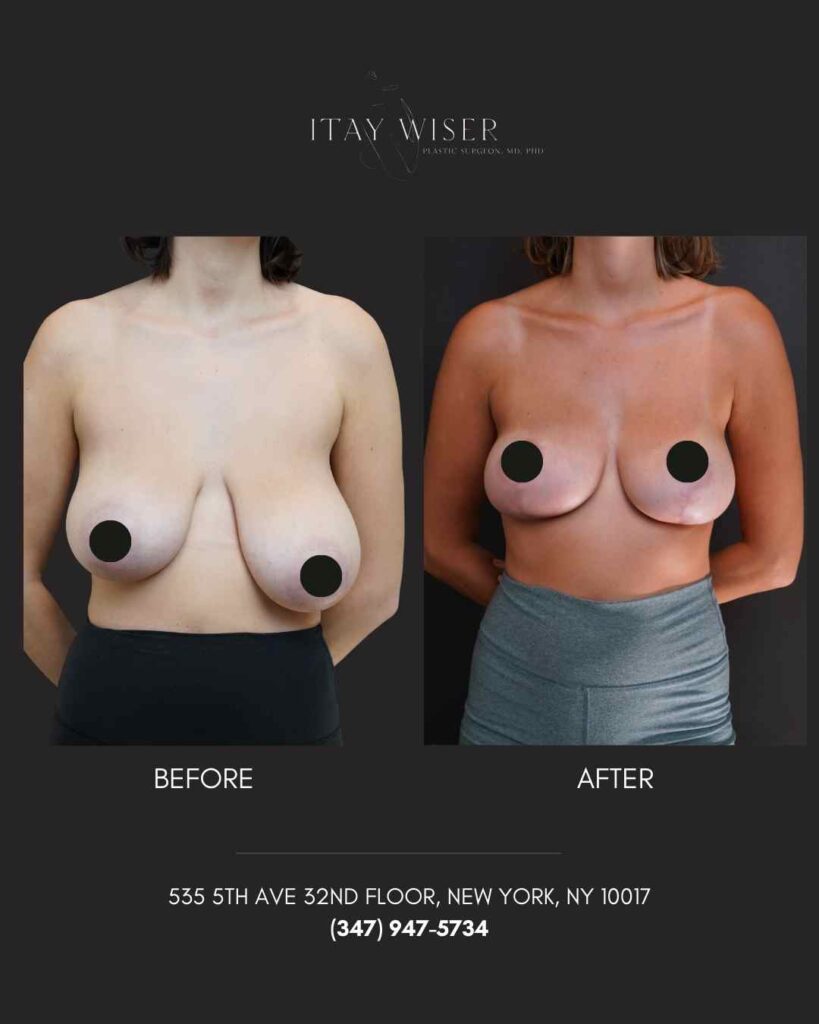
Before & After

Why Patients Trust Dr. Wiser

Associate Clinical Professor of Surgery, Mount Sinai Elmhurst

Thousands of successful
procedures

Advanced techniques for natural-looking results
Breast asymmetry
Signs you may recognize
- One breast a cup size or more larger than the other.
- Nipples at different heights, or one areola larger than the other.
- One breast that sits lower, or has a different shape or fold position.
- Bras that fit one side and not the other; padding one cup.
Why it happens
Almost every woman has some asymmetry. Noticeable asymmetry can be developmental, or can follow pregnancy, breastfeeding, weight change, previous surgery or a chest-wall difference such as pectus or Poland syndrome. In most cases there is no medical cause to treat; the question is whether the difference bothers you.
How asymmetry is corrected
Correction matches the two sides using whichever procedure each breast needs: a breast lift or breast reduction on the larger or lower side, an implant or fat transfer on the smaller side, or both. Dr. Wiser plans each breast separately and operates on both in one session so the pair matches.
Tuberous (tubular) breasts
Signs you may recognize
- A narrow breast base, so the breast seems to project forward from a small footprint.
- A breast fold that sits higher than usual.
- Breast tissue that appears to herniate into a puffy, enlarged areola.
- A wide space between the breasts.
- Often more pronounced on one side, so asymmetry is part of the picture.
Why it happens
Tuberous breast is congenital: a ring of constricting tissue at the base of the breast limited its expansion during puberty. It is not caused by anything you did, and it is more common than most women realize because it is rarely discussed. Many patients first learn the name at their consultation.
How tuberous breasts are corrected
Correction releases the constricting tissue from inside so the breast can expand, lowers the fold to a normal position, reduces the areola if it is enlarged, and adds volume with an implant or fat transfer where the lower breast is empty. Milder cases may need only an implant or fat; more pronounced cases combine release, lift and volume, sometimes in two stages. Read tuberous breast correction explained for a full guide by severity.
Correction approaches by severity
| What you see | Usual approach | Stages |
|---|---|---|
| Mild asymmetry (less than a cup size), same shape | Fat transfer or a small implant on the smaller side | One |
| Marked asymmetry (a cup size or more) | Reduction or lift on the larger side, implant or fat on the smaller side, or both | One |
| Mild tuberous shape, adequate volume | Release of constricted tissue, areola reduction, fold lowering | One |
| Tuberous shape with an empty lower breast | Release plus implant or fat transfer; sometimes a lift | One or two |
| Pronounced tuberous shape, very tight skin | Tissue expander or staged fat transfer first, then implant or final shaping | Two |
A planning guide, not a promise; the combination is decided for your anatomy at the consultation.
What happens at the consultation
Dr. Wiser measures both breasts (base width, fold position, nipple height, areola size), photographs them for planning and, if relevant, for the insurance file, and explains what he sees in plain terms. You leave with a written plan naming the procedure for each breast, the number of stages, the expected scars and a cost or coverage estimate. Many patients tell him it is the first time anyone has explained their breasts to them.
Insurance for asymmetry and tuberous breast correction
Because tuberous breasts and marked asymmetry can be classified as congenital deformities, some plans cover correction, particularly when the difference is significant and well documented with photographs and measurements. Approval varies more here than for any other breast procedure. Dr. Wiser's team verifies your benefits and prepares the documentation before scheduling, and provides a written self-pay estimate with financing options when coverage does not apply.
Recovery and what to expect
Recovery follows the procedures used: about a week off desk work for implant-based correction, one to two weeks when a lift or reduction is involved, exercise at four to six weeks, and a support bra for the first four weeks. Dr. Wiser performs a regional nerve block during surgery to keep early discomfort low. Tuberous correction in two stages spaces the operations several months apart so the released tissue settles before volume is finalized.
Correction in Manhattan
Dr. Wiser sees patients at 535 Fifth Avenue, 32nd Floor, in Midtown Manhattan. Consultations are available in person or by video, which many patients prefer for a first conversation about a condition they have never discussed. Phone: 347-947-5734.
Frequently asked questions
How do I know if I have tuberous breasts?
Common signs are a narrow breast base, a breast fold that sits high, breast tissue that seems to point forward from a small footprint, a puffy or enlarged areola, and a wide gap between the breasts. One breast is often more affected than the other. Dr. Wiser confirms the diagnosis by examination; you do not need to be certain before you book.
Is tuberous breast the same as tubular breast?
Yes. Tuberous, tubular and constricted breast all describe the same congenital condition, in which the tissue at the base of the breast did not expand normally during development.
Does insurance cover tuberous breast or asymmetry correction?
Sometimes. Because tuberous breasts and marked asymmetry can be classified as congenital deformities, some plans cover correction, particularly when the difference is significant and well documented with photographs and measurements. Approval varies more here than for any other breast procedure, and Dr. Wiser's team verifies your benefits before scheduling.
How much asymmetry is normal?
Almost every woman has some difference between her breasts. A difference of a full cup size or more, a clearly different nipple height, or a different breast shape is the point at which many women seek correction.
What does correction surgery involve?
It depends on the condition and severity: releasing constricted tissue from inside so the breast can expand, lowering a high fold, reducing a puffy areola, adding an implant or fat to one or both sides, or lifting or reducing one breast to match the other. Most patients need a combination, planned for their anatomy.
Will my breasts be perfectly symmetrical afterward?
The goal is breasts that look like a matched pair in clothing and in a mirror. Perfect symmetry is not achievable in any breast surgery, and Dr. Wiser shows you before-and-after photographs so your expectations are realistic.
A conversation, not a judgment
At the free virtual consultation Dr. Wiser examines both breasts, names what he sees, and explains the combination of procedures that would make them a matched pair. Compare healed results in the before-and-after gallery.
About the author. Dr. Itay Wiser, MD, PhD is Associate Clinical Professor of Surgery at Mount Sinai Elmhurst Hospital. He completed a reconstructive microsurgery fellowship in aesthetic and reconstructive breast surgery at Lenox Hill Hospital and a lymphedema surgery fellowship at Memorial Sloan Kettering Cancer Center, and holds a PhD in epidemiology and public health. He practices at 535 Fifth Avenue in Manhattan.
Medical disclaimer: This article is for general education and does not replace an individual consultation. Recovery times are typical ranges and insurance criteria vary by plan.