

Breast Lift in NYC: Restore Shape Without Implants
By Dr. Itay Wiser, MD, PhD, Associate Clinical Professor of Surgery at Mount Sinai Elmhurst Hospital, fellowship-trained in aesthetic and reconstructive breast surgery at Lenox Hill Hospital. Medically reviewed September 2026.
A breast lift (mastopexy) raises the breast, repositions the nipple and areola and removes the excess skin that has stretched over time, so the breast sits higher and firmer without changing its size much. It is the procedure for breasts that have dropped after pregnancy, breastfeeding, weight loss or age while keeping the volume you already have. Dr. Itay Wiser performs breast lifts in NYC alone, combined with implants or fat transfer for volume, or combined with implant removal for patients who no longer want implants.
Is a breast lift right for you?
Women consider a mastopexy when the breast has changed position more than size. The signs are recognizable:
- Nipples that point downward or sit at or below the breast fold.
- A breast that looks deflated or empty in the upper half but full at the bottom.
- Stretched or enlarged areolas.
- Skin that has lost elasticity after pregnancy, breastfeeding or weight loss.
- One breast that sits noticeably lower than the other.
If heaviness, pain or skin irritation are the main problem, the answer is a breast reduction in NYC, which includes a lift. If you are deciding among all the breast options, the complete guide to breast surgery in NYC compares them side by side.
Table of Contents
Why Patients Trust Dr. Wiser

Fellowship-Trained NYC Plastic Surgeon

Associate Clinical Professor of Surgery, Mount Sinai Elmhurst

Advanced techniques for natural-looking results

Thousands of successful
procedures
Breast Lift: Before & After
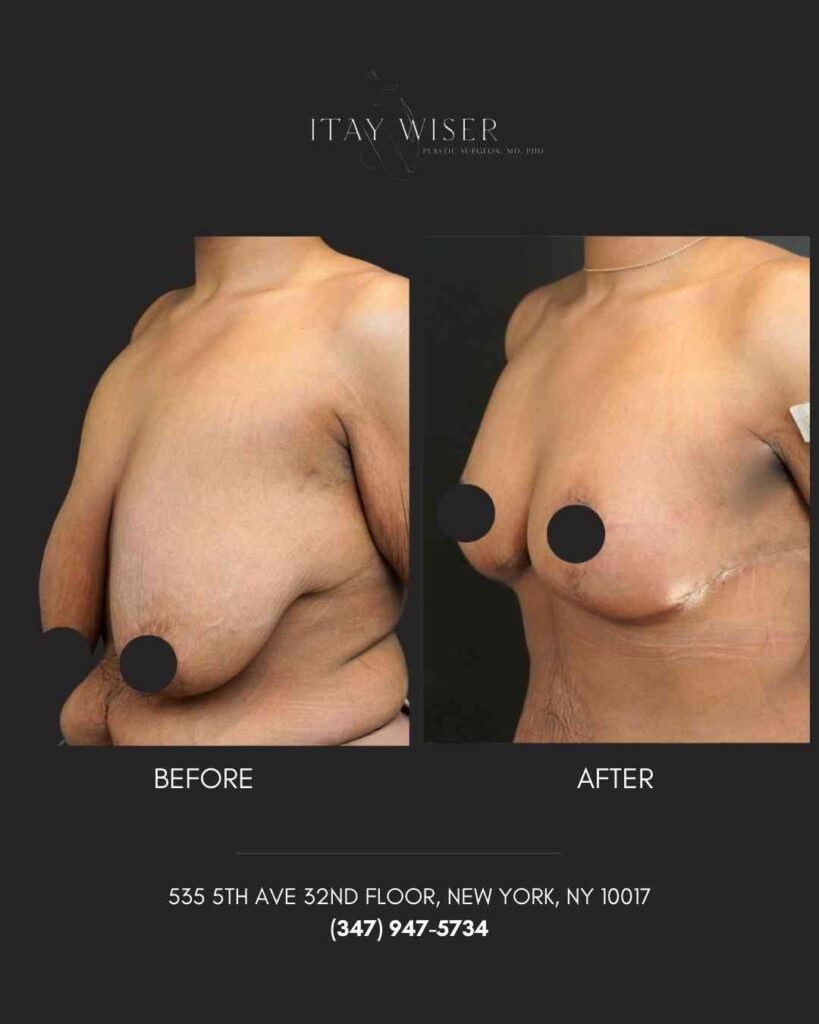
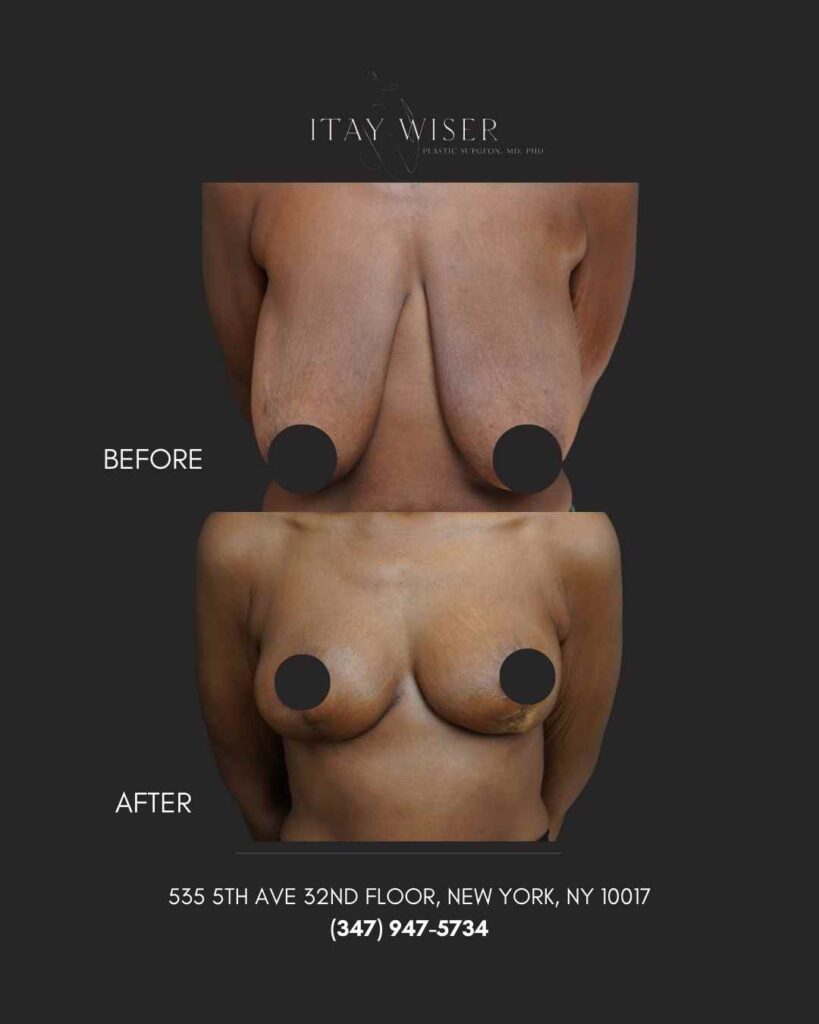
How surgeons grade sagging (ptosis)
Surgeons describe breast droop in grades, and the grade guides the incision pattern. Where your nipple sits relative to the fold under the breast is the key measurement.
| Grade | Where the nipple sits | What it usually means for surgery |
|---|---|---|
| Mild (grade 1) | At the level of the breast fold | A periareolar lift, or an implant alone if the goal is volume |
| Moderate (grade 2) | Below the fold but above the lowest point of the breast | A lollipop (vertical) lift |
| Advanced (grade 3) | At the lowest point of the breast, pointing down | A lollipop or anchor lift; often a lift with implant or fat transfer if the upper breast is empty |
| Pseudoptosis | Nipple above the fold, but the breast tissue has dropped below it | Often an implant or fat transfer; sometimes a limited lift |
Grades are a guide; Dr. Wiser measures and photographs you at the consultation and shows you where the incisions would sit.
Lift, augmentation, or both?
This is the question most patients bring to the consultation, and the table below is how Dr. Wiser answers it.
| Your situation | Usual answer | Why |
|---|---|---|
| Happy with size in a bra; breast has dropped | Breast lift alone | Position is the problem; adding volume makes the breast heavier and can worsen sag over time |
| Breast has dropped and lost volume, especially in the upper half | Lift with implants or fat transfer | Lift fixes position, volume fixes fullness; one operation does both |
| Position is fine; want more fullness | Breast augmentation | No skin needs removing |
| Removing implants and worried about loose skin | Implant removal with lift | Excess skin is reshaped in the same operation |
| Breasts feel heavy or cause pain | Breast reduction (includes a lift) | Volume is the problem, as well as position |
The article breast lift vs augmentation works through the decision in more detail, and the breast augmentation in NYC page covers implant and fat transfer options.
Mastopexy techniques and where the scars go
Every breast lift leaves scars. Dr. Wiser chooses the least extensive pattern that can safely achieve your shape.
- Periareolar (donut) lift. An incision around the edge of the areola. For mild sag and for reducing areola size; limited lifting power.
- Lollipop (vertical) lift. Around the areola plus a vertical line to the breast fold. The most common mastopexy pattern; handles moderate sag with no scar in the fold.
- Anchor (inverted-T) lift. The lollipop plus a horizontal line along the fold. For advanced sag or large amounts of excess skin; the most reshaping control and the longest scar, hidden in the crease.
Stitches are internal and dissolvable. Scars are most visible in the first months and continue to fade over the first year and beyond; patients with a genetic tendency toward thickened or darkened scars are told this before surgery.
Breast lift after pregnancy and breastfeeding
Pregnancy stretches the skin envelope and breastfeeding fills and then empties the gland, which is why so many lifts are performed after children. Dr. Wiser recommends waiting until you have finished breastfeeding for several months so the breast has settled. Many mothers combine a lift with a tummy tuck or liposuction as a mommy makeover in NYC.
Breast lift after major weight loss
Losing 50 pounds or more changes the breast differently: the fatty volume disappears and the stretched skin does not retract, leaving a deflated, low breast. Whether a lift alone is enough, or a lift with an implant or a lift that repositions your own remaining tissue is better, depends on how much tissue remains. Surgery should wait until your weight has been stable for several months; Dr. Wiser's surgical weight optimization program helps patients on GLP-1 medications or after bariatric surgery reach that point. Read breast lift after weight loss for the full comparison, and body contouring after weight loss for how breast and body surgery are staged.
Breast lift after implant removal
Removing implants after years often leaves stretched skin and a lower nipple position. Combining breast implant removal with a lift in the same operation reshapes the breast so it looks natural without implants, and avoids a second surgery. For patients who want some volume back without a device, fat transfer can be added.
Surgery day and recovery
A breast lift is an outpatient procedure under general anesthesia, usually two to three hours depending on the pattern and whether implants or fat transfer are added. During surgery Dr. Wiser performs a regional nerve block with a long-acting local anesthetic, which the practice reports keeps discomfort low through the first days.
| Timeframe | What to expect | What you can do |
|---|---|---|
| Days 1 to 3 | Soreness and tightness managed with medication; swelling begins | Rest, short walks, sleep on your back propped up |
| Week 1 | Swelling and bruising peak then start to settle; first follow-up | Light activity; showering per instructions |
| Weeks 2 to 3 | Most patients are comfortable at a desk | Return to work and driving; support bra worn continuously |
| Weeks 4 to 6 | Incisions healed; shape starts to settle | Gradual return to exercise, chest work last; support bra through week four |
| Months 3 to 12 | Final shape develops; scars flatten and fade; sensation usually returns by six to eight weeks | Scar care as directed |
Typical ranges reported by the practice, not guarantees. Recovery timelines vary depending on the patient, the procedure and individual healing.
Breast lift cost in NYC
A breast lift on its own is usually considered cosmetic, though coverage depends on your plan and your circumstances. The total depends on the incision pattern, whether implants or fat transfer are included, facility and anesthesia fees and follow-up care. Dr. Wiser's team gives a written, all-inclusive estimate at your consultation and offers financing; the breast lift cost in NYC guide explains what changes the number. The American Society of Plastic Surgeons' overview of breast lift surgery describes the procedure in general terms.
Breast lift in Manhattan
Dr. Wiser sees patients at 535 Fifth Avenue, 32nd Floor, in Midtown Manhattan, a few blocks from Grand Central Terminal. Consultations are available in person or by video. Phone: 347-947-5734.
Frequently asked questions about breast lift in NYC
Do I need a breast lift or implants?
If you are happy with your size in a bra but the breast has dropped, a lift alone restores position and shape. If the breast has dropped and lost volume, a lift with implants or fat transfer does both. If position is fine and you want more fullness, implants alone. Dr. Wiser confirms which applies at the consultation.
How long does a breast lift last?
The lift itself is lasting; the tissue that is removed does not return. Aging, pregnancy, breastfeeding and significant weight change continue to affect the breast over time, so results last longest in patients who are at a stable weight and finished having children.
Will a breast lift change my nipple sensation?
Some reduction in sensation is common in the first weeks and usually returns over roughly six to eight weeks as stretched nerves recover. A permanent change is possible but uncommon, and Dr. Wiser discusses the likelihood for your anatomy before surgery.
Is a breast lift covered by insurance?
Coverage for a breast lift depends on your insurance plan and the circumstances of your surgery. A lift performed on its own is often considered cosmetic, but there may be situations where a lift is included as part of a covered breast reduction or performed for symmetry during breast reconstruction. Our team can help you understand your plan's requirements and whether coverage may apply to your case.
Can I have a breast lift after breast implant removal?
Yes, and it is one of the most common combinations. Removing implants often leaves excess skin; a lift performed in the same operation reshapes the breast so it looks natural without them.
What does a breast lift cost in NYC?
The total depends on the incision pattern, whether implants or fat transfer are added, facility and anesthesia fees, and follow-up care. Dr. Wiser's team provides a written, all-inclusive estimate at the consultation and offers financing. The breast lift cost guide explains what drives the number.
See what a lift can do for your shape
At the free virtual consultation Dr. Wiser measures your ptosis grade, shows you where the incisions would sit, and tells you whether a lift alone or a lift with volume fits your goals. Compare healed results in the before-and-after gallery.
About the author. Dr. Itay Wiser, MD, PhD is Associate Clinical Professor of Surgery at Mount Sinai Elmhurst Hospital. He completed a reconstructive microsurgery fellowship in aesthetic and reconstructive breast surgery at Lenox Hill Hospital and a lymphedema surgery fellowship at Memorial Sloan Kettering Cancer Center, and holds a PhD in epidemiology and public health. He practices at 535 Fifth Avenue in Manhattan.
Medical disclaimer: This article is for general education and does not replace an individual consultation. Recovery times are typical ranges and insurance criteria vary by plan.