

Non-Surgical Hair Restoration in NYC: PRP and PRF Treatment
By Sarah Walner, PA-C, lead injector at WiserMD. Medically reviewed by Dr. Itay Wiser, October 2026.
Non-surgical hair restoration at this practice uses PRP (platelet-rich plasma) or PRF (platelet-rich fibrin): healing factors concentrated from a small sample of your own blood and injected into thinning areas of the scalp to support the follicles. It suits men and women with thinning that is still active, needs no surgery and little downtime, and is delivered as a series of sessions followed by maintenance. Sarah Walner, PA-C leads hair restoration at the practice.
Table of Contents
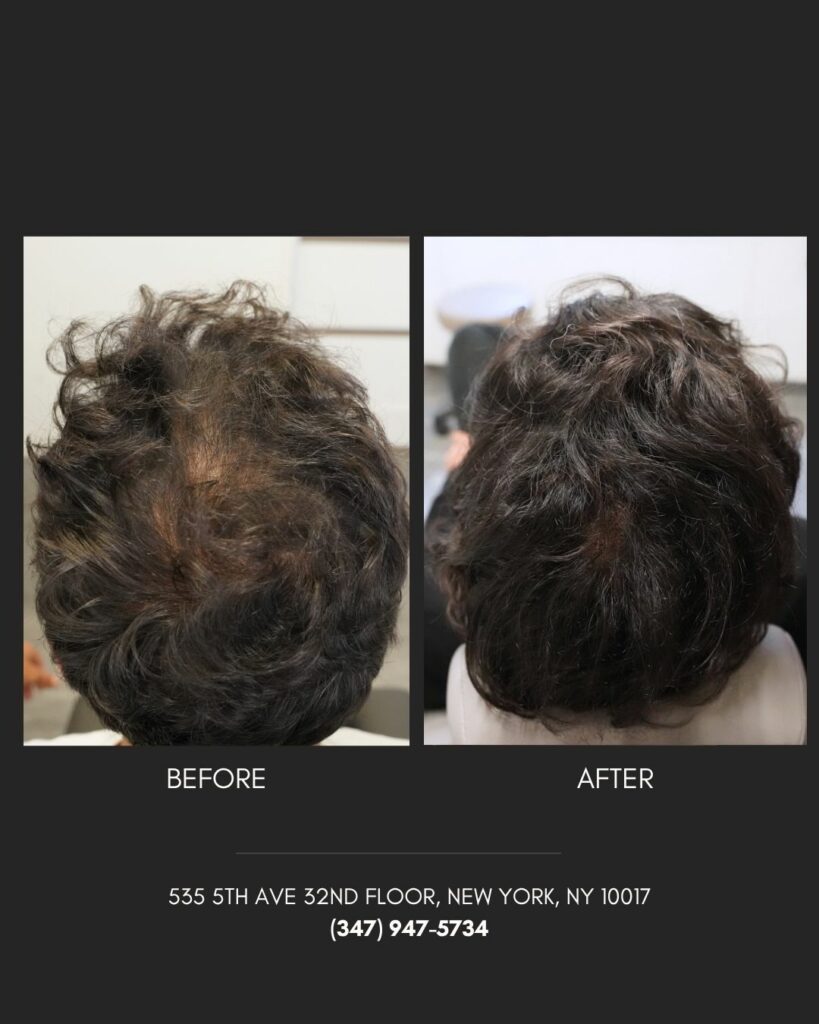
Hair Restoration: Before & After
Why Patients Trust Dr. Wiser

Associate Clinical Professor of Surgery, Mount Sinai Elmhurst

Advanced techniques for natural-looking results

Thousands of successful
procedures
What PRP and PRF are
Both start the same way: a small blood draw, about the size of a routine test, spun in a centrifuge to concentrate the platelets and the growth factors they release. The concentrate is then injected into the scalp where hair is thinning, after numbing, in a session of under an hour. The growth factors are thought to support follicles that have been shrinking, lengthen the growth phase, and improve hair thickness.
| PRP (platelet-rich plasma) | PRF (platelet-rich fibrin) | |
|---|---|---|
| How it is prepared | Anticoagulant added; faster spin | No anticoagulant; slower spin |
| What it contains | Concentrated platelets in plasma | Platelets, white cells and a fibrin matrix |
| How it releases growth factors | Mostly at once | More gradually over days |
| Session and downtime | Under an hour; minimal downtime | Under an hour; minimal downtime |
| Often chosen for | Well-established protocols for pattern thinning | Patients who want a slower release or have responded partly to PRP |
Results vary by patient, by the cause and stage of hair loss, and by how consistently the treatment plan is followed.
PRP is not FDA-approved specifically for pattern hair loss, and the research is mixed but trending positive: a 2023 review in the Journal of the American Academy of Dermatology describes it as promising despite varied study results and non-standardized preparation, and the American Academy of Dermatology notes studies show it can be a safe and effective option (AAD on hair loss treatment; JAAD review00768-5/fulltext)). The full comparison is in PRP vs PRF for hair.
Two pathways: women and men
Hair restoration for women
Women's thinning is often diffuse or along the part, and causes include hormonal changes, thyroid conditions, stress, nutrition and the months after pregnancy. Identifying the cause comes first. See hair restoration for women in NYC, and if your shedding began after a baby, postpartum hair loss.
Hair restoration for men
Men's thinning is usually pattern hair loss, receding at the temples and thinning at the crown, staged on the Norwood scale. PRP and PRF are most effective while follicles are still present and are often used to thicken and maintain. See hair restoration for men in NYC.
Sessions, results and cost
- Sessions. An initial series of three or four sessions about a month apart, then maintenance every few months.
- Results. Reduced shedding first, then early regrowth and thickening over several months; see the month-by-month results timeline.
- Cost. Priced per session or as a package; see PRP hair cost in NYC.
Results vary by patient, by the cause and stage of hair loss, and by how consistently the treatment plan is followed.
An honest note on hair transplants
The practice does not perform surgical hair transplants. For advanced, stable baldness with a good donor area, a transplant may be the better answer, and Sarah will say so and refer you. For thinning that is still active, or for patients who want a non-surgical option, PRP or PRF is a reasonable first step and is sometimes used alongside a transplant. Read PRP vs hair transplant.
Who performs your treatment
Sarah Walner, PA-C, joined WiserMD in 2024 after receiving her Master of Science in Physician Assistant Studies from Midwestern University. Before her physician assistant studies, she received her Bachelor of Science in Human Development from the University of Wisconsin-Madison. After becoming a certified physician assistant in 2024, Sarah began her career as a plastic surgery PA with Dr. Wiser. She has assisted in a wide range of cosmetic surgical procedures, including body contouring, breast surgery, facelift and blepharoplasty. Sarah is also the lead injector at WiserMD, specializing in natural, non-surgical facial rejuvenation with Botox, filler and microneedling. Plans are medically reviewed by Dr. Itay Wiser, Associate Clinical Professor of Surgery at Mount Sinai Elmhurst Hospital.
Results
The before-and-after gallery includes hair restoration cases. At the consultation Sarah shows you results from patients with similar hair loss and tells you plainly what PRP or PRF can and cannot do for you.
Questions patients ask about PRP and PRF hair restoration
What is the difference between PRP and PRF?
Both concentrate healing factors from a small sample of your own blood and are injected into the scalp. PRP (platelet-rich plasma) uses an anticoagulant and a faster spin; PRF (platelet-rich fibrin) uses no anticoagulant and a slower spin, forming a fibrin matrix that releases growth factors more gradually. Sarah recommends one based on your hair loss and history.
Does PRP work for women?
Often, yes. Women with pattern thinning, especially along the part, are among the patients who tend to respond, and some research suggests female sex is associated with better response. The cause of thinning is identified first, because shedding from a medical cause needs that cause treated.
How much does PRP hair restoration cost?
It is priced per session or as a package, and the total depends on how many sessions your plan needs and the maintenance schedule. The cost guide explains how the number is built; the practice gives a written estimate at the consultation.
How many sessions will I need?
A typical plan is an initial series of three or four sessions about a month apart, then maintenance sessions every few months. Sarah sets the number for your hair loss.
How long until I see results?
Most patients notice reduced shedding first, then early regrowth and thickening over several months; results are judged after the initial series. Results vary by patient, by the cause and stage of hair loss, and by how consistently the treatment plan is followed.
Is a hair transplant better?
For some patients, yes: those with advanced, stable baldness and a good donor area may need surgical transplantation, which this practice does not perform. For thinning that is still active, or for patients who want a non-surgical option, PRP or PRF is a reasonable first step. The comparison guide explains who suits which.
Curious if PRP or PRF is right for you?
A free virtual consultation with Sarah looks at your hair loss pattern and history, explains what to expect, and gives a written estimate. The virtual consultation guide explains how to prepare.
About the author. Sarah Walner, PA-C, joined WiserMD in 2024 after receiving her Master of Science in Physician Assistant Studies from Midwestern University. Before her physician assistant studies, she received her Bachelor of Science in Human Development from the University of Wisconsin-Madison. After becoming a certified physician assistant in 2024, Sarah began her career as a plastic surgery PA with Dr. Wiser. She has assisted in a wide range of cosmetic surgical procedures, including body contouring, breast surgery, facelift and blepharoplasty. Sarah is also the lead injector at WiserMD, specializing in natural, non-surgical facial rejuvenation with Botox, filler and microneedling. Every treatment plan is medically reviewed by Dr. Itay Wiser, Associate Clinical Professor of Surgery at Mount Sinai Elmhurst Hospital.
Medical disclaimer: This page is for general education and does not replace an individual consultation. Results and longevity vary by patient and product.