
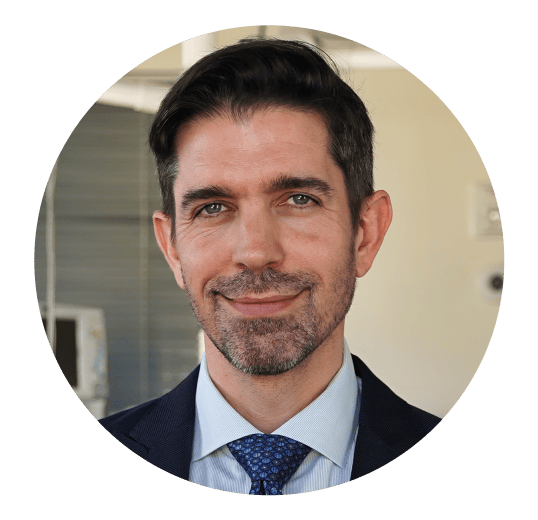
By Dr. Itay Wiser, MD, PhD, Associate Clinical Professor of Surgery at Mount Sinai Elmhurst Hospital, fellowship-trained in aesthetic and reconstructive breast surgery at Lenox Hill Hospital. Medically reviewed October 2026.
Pinch the tissue directly behind your nipple. If you feel a firm, rubbery disc that does not change much with weight, that is glandular tissue, and the condition is gynecomastia. If the tissue is soft and uniform, like the rest of your chest, and shrinks when you lose weight, it is fat (pseudogynecomastia). Many men have both. Gland does not respond to diet or training; fat does. Dr. Itay Wiser explains the signs and when a consultation makes sense.
The pinch test, step by step
- Stand in front of a mirror with your chest relaxed.
- Place your thumb and index finger on either side of the nipple and pinch the tissue directly behind it.
- Feel for a disc. Gland is firm and rubbery, often the size of a coin or larger, centered under the areola. Fat is soft and spreads evenly.
- Compare sides. Gland is often more developed on one side; fat is usually symmetrical.
- Note tenderness. Gland is sometimes tender, especially when it is new; fat is not.
Gland versus fat
- Where it sits. Gland is centered under the areola. Fat spreads across the chest and toward the armpit.
- How it feels. Gland: firm, rubbery, a defined disc. Fat: soft, uniform, no edge.
- How it responds to weight. Fat shrinks with weight loss and grows with gain. Gland stays about the same.
- The nipple. A puffy or projecting nipple that stays puffy when cold points to gland behind it.
- How it is treated. Fat alone: weight loss, then liposuction if needed. Gland: surgical removal; liposuction alone leaves it.
Why diet and training do not remove gland
Chest exercises build the pectoral muscle beneath the tissue, which can make a glandular chest look more prominent, not less. Weight loss removes fat around the gland and often reveals the disc more clearly. Gland is a different tissue from both, and once it has persisted beyond a year or two it has usually become fibrous and does not regress. That is not a failure of effort; it is biology.
When to see a surgeon
If the pinch test finds a firm disc, if the fullness has not changed with weight loss and training, if the tissue is tender, or if it is affecting what you wear and do, a consultation answers the question in minutes and is a better use of time than another chest program. The gynecomastia surgery in NYC page explains the grades and techniques; the plastic surgery for men in NYC page covers both men's procedures. In some cases gynecomastia surgery may be covered by insurance; see the cost and insurance guide.
Questions men ask
What is pseudogynecomastia?
Chest fullness caused by fat alone, with no glandular tissue. It responds to weight loss and, when it does not, to liposuction. True gynecomastia involves gland and does not respond to weight loss.
Can I have both gland and fat?
Yes, and most men do. A glandular disc behind the nipple with fat around it is the usual picture, which is why liposuction alone often leaves the nipple area puffy.
Will losing weight fix my chest?
If the fullness is fat, losing weight shrinks it. If a firm disc remains behind the nipple when you are lean, that is gland, and no amount of weight loss or training removes it.
When should I see a surgeon?
When a firm disc has persisted for more than a year or two, when the fullness has not changed with weight loss and training, when the tissue is tender, or when it affects what you wear and do. A consultation settles the question in minutes.
Get the answer in minutes
At the free virtual consultation Dr. Wiser tells you whether gland is present, what it would take to treat it, and whether coverage may apply.
About the author. Dr. Itay Wiser, MD, PhD is Associate Clinical Professor of Surgery at Mount Sinai Elmhurst Hospital. He completed a reconstructive microsurgery fellowship in aesthetic and reconstructive breast surgery at Lenox Hill Hospital and a lymphedema surgery fellowship at Memorial Sloan Kettering Cancer Center, and holds a PhD in epidemiology and public health. He practices at 535 Fifth Avenue in Manhattan.
Medical disclaimer: This page is for general education and does not replace an individual consultation. Recovery timelines vary by patient and insurance coverage depends on your plan.