
Hair Restoration for Men in NYC: PRP for Pattern Hair Loss
By Sarah Walner, PA-C, lead injector at WiserMD. Medically reviewed by Dr. Itay Wiser, October 2026.
Most men's hair loss is pattern hair loss: a hereditary sensitivity of follicles at the temples and crown to DHT, a hormone derived from testosterone, which makes them shrink over years. PRP and PRF can thicken and maintain hair while those follicles are still present, which is why timing matters. Sarah Walner, PA-C assesses your stage on the Norwood scale and tells you plainly what to expect.
For the treatment itself, see non-surgical hair restoration in NYC; for the practice's other men's procedures, plastic surgery for men in NYC.
Where are you on the Norwood scale?
- Stage 1 to 2. Minimal recession at the temples. Monitoring, prevention, or PRP to protect density.
- Stage 3. Visible recession at the temples, sometimes early crown thinning. A common point to start PRP.
- Stage 4 to 5. Deeper recession and a thinning crown, with a band of hair between. PRP for thickness where follicles remain; expectations set carefully.
- Stage 6 to 7. Extensive baldness. PRP has limited value on bald areas; a transplant consultation usually makes more sense.
Why it happens
Pattern hair loss is genetic. Follicles in the temples and crown are sensitive to DHT, which gradually shortens their growth phase and makes each hair finer, until some stop producing visible hair. The process is slow and continues, which is why treatment is most effective early and why maintenance matters.
What PRP can and cannot do for men
PRP and PRF support follicles that are still present: thicker hair, less shedding, better coverage in thinning areas. They do not create follicles where none remain, so long-bald areas are not where they help. Many men combine PRP with medication from their physician, and some use it to support a transplant. Read PRP vs hair transplant for when surgery is the better route.
Table of Contents
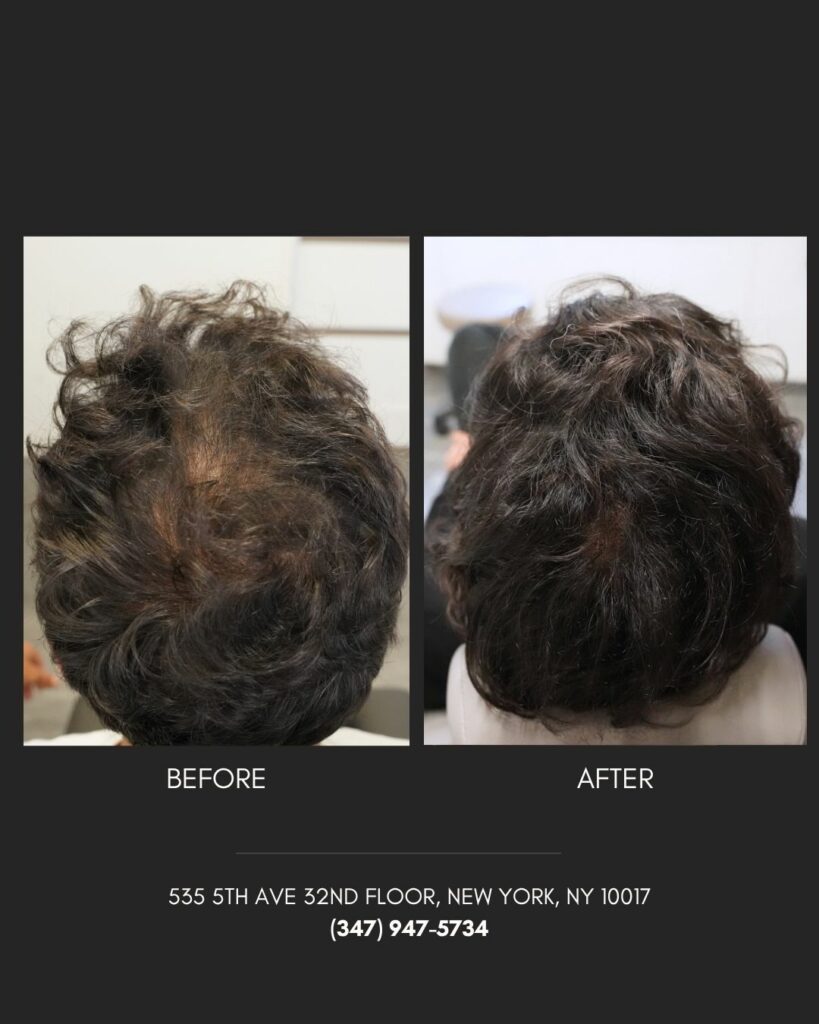
Hair Restoration: Before & After
Why Patients Trust Dr. Wiser

Associate Clinical Professor of Surgery, Mount Sinai Elmhurst

Advanced techniques for natural-looking results

Thousands of successful
procedures
Treatment, results and Queens patients
An initial series of three or four sessions about a month apart, then maintenance every few months; less shedding first, then thickening over several months. Results vary by patient, by the cause and stage of hair loss, and by how consistently the treatment plan is followed. The results timeline and cost guide cover the details. Many patients come from Queens; hair restoration in Queens explains the trip and the virtual-consultation option.
Questions men ask about hair restoration
Will PRP regrow a bald spot?
PRP and PRF work on follicles that are still present but shrinking. Areas that have been completely bald for a long time usually have no follicles left to stimulate, and a transplant is the option there. Thinning areas are where PRP tends to help.
Which Norwood stages suit PRP?
Early to moderate stages (roughly 2 to 4), where thinning is visible but follicles remain. Later stages may still benefit for thickness, but expectations change and a transplant consultation may make sense.
Can I combine PRP with finasteride or minoxidil?
Often, and many men do; the treatments work differently. Discuss medication with your physician or dermatologist; Sarah coordinates the plan.
How long do results last?
Pattern hair loss continues, so maintenance sessions every few months help hold the result. Results vary by patient, by the cause and stage of hair loss, and by how consistently the treatment plan is followed.
Find out where you stand
At the free virtual consultation Sarah assesses your stage and tells you whether PRP or PRF fits, or whether a transplant consultation makes more sense.
About the author. Sarah Walner, PA-C, joined WiserMD in 2024 after receiving her Master of Science in Physician Assistant Studies from Midwestern University. Before her physician assistant studies, she received her Bachelor of Science in Human Development from the University of Wisconsin-Madison. After becoming a certified physician assistant in 2024, Sarah began her career as a plastic surgery PA with Dr. Wiser. She has assisted in a wide range of cosmetic surgical procedures, including body contouring, breast surgery, facelift and blepharoplasty. Sarah is also the lead injector at WiserMD, specializing in natural, non-surgical facial rejuvenation with Botox, filler and microneedling. Every treatment plan is medically reviewed by Dr. Itay Wiser, Associate Clinical Professor of Surgery at Mount Sinai Elmhurst Hospital.
Medical disclaimer: This page is for general education and does not replace an individual consultation. Results and longevity vary by patient and product.